For your 2027 GRAMMY Consideration
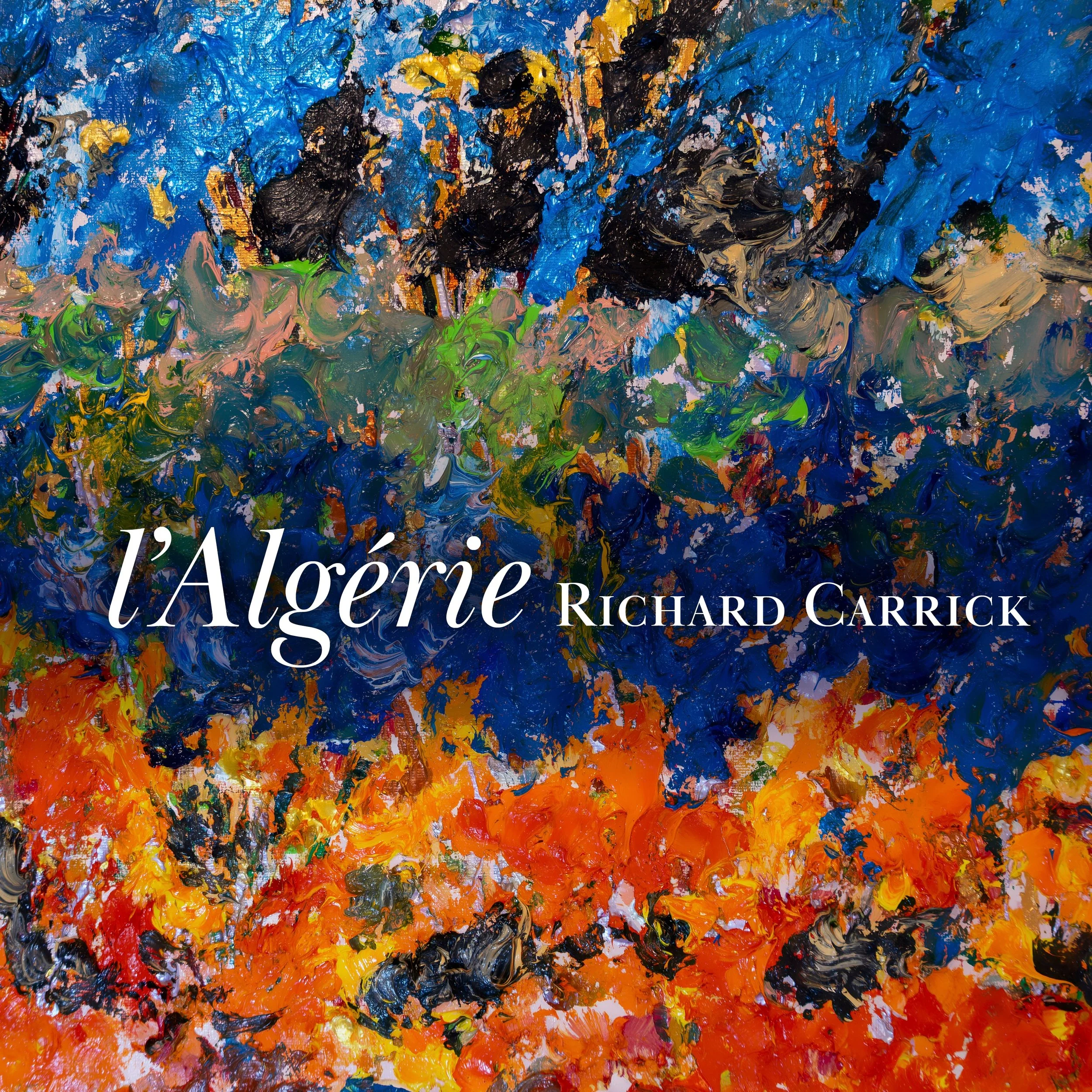
Released on New Focus Recordings on Jan 30, 2026
Richard Carrick: L’Algérie
Best Contemporary Classical Composition
L’Algérie by Richard Carrick, for Extended Piano, Oud, Violin, Cello, and Hand Percussion, in nine movements, 45 minutes duration.
Best Chamber Music/Small Ensemble Performance
Either/Or: Bahar Badieitabar Oud, Richard Carrick Piano, Jennifer Choi Violin, John Popham Cello, Justin Jay Hines Percussion recorded on October 1, 2024 at Miller Theatre, Columbia University, New York, NY.
Best Engineered Album, Classical
John Escobar and Joseph Branciforte
Listen
Available on all streaming services including
Apple Music, Spotify, Tidal, Bandcamp
Reviews
Nothing else sounds quite like l'Algérie, the second album-length chapter in a trilogy composed by pianist Richard Carrick (b. 1971) and performed by Either/Or, the chamber quintet he co-founded and co-artistic directs. As its title inmates, the nine-part work was inspired, in part, by the music of the Maghreb region of North Africa and by extension Carrick's own family background (his mother was born in the town of Aïn Bessem in northern Algeria). In fusing formal composition and musical elements that evoke that North African subregion, Carrick, a Paris-born US/French citizen of French-Algerian and British descent, has created something wholly distinctive and engaging. _ Textura
While l'Algérie can be experienced on purely musical grounds, it also allows the listener to treat it as a travelogue through the Algerian region. It qualifies as both an imagined public journey and personal meditation on family history. That the work refuses to be easily categorized—the catch-all world music makes the most sense, even if it ventures into folk, classical, and jazz—is one of the things that recommends it. In being performed by quintet, the work feels intimate; at the same time, pronounced timbral contrasts make the group seem larger than it is._ Textura
About the Artists
Composer, conductor and pianist Richard Carrick is a composer who writes music of spatial depth and robust stasis, characterized by the evocation of profound human experiences. Described as "organic and restless" by The New York Times, Carrick's music has been presented internationally at festivals including NYPHIL Biennial, ISCM World Music Days, Enescu Festival, released on numerous critically acclaimed CDs, and published by PSNY. A recipient of numerous awards including a s Guggenheim Fellowship and Fromm Foundation Commission, his music spans solo, chamber and orchestral compositions as well as works incorporating dance, graphic scores, electronics, video projection, and conducted group improvisation. Carrick has presented concerts, master classes and lectures throughout the US, Europe, Israel, Rwanda, Japan, and South Korea, where he was a Korean Gugak Fellow in 2015. He currently serves as Chair of Composition at Berklee College and director of the Experimental New Music Ensemble Either/Or in NYC, with former faculty appointments at Columbia and New York Universities and as New York Philharmonic Teaching Artist for the Very Young Composers Program.
Either/Or (EO) is a flexible chamber ensemble based in New York City advancing a repertoire drawn from a wide spectrum of experimental traditions. Winner of the 2015 CMA/ASCAP Award for Adventurous Programming, EO presents inclusive concert experiences; vital composer portraits, explorations of graphic score approaches; and carefully curated sets of works. EO’s Directors Richard Carrick and Chris McIntyre draw on a broad collective of 10 regular soloists and guests to realize the specific requirements of each project. Since forming in 2004, the group has premiered more than 300 works (as well as dozens of student compositions), toured throughout the US and Sweden, and recorded for labels such as New Focus, New World Records, Starkland, and Sterling Classics.
CD Linear Notes by Shaun Brady
Composer and pianist Richard Carrick conjures an evocative travelogue for an imagined journey through Algeria on his compelling new album-length work, l’Algérie. The second part of a trilogy of large-scale works inspired in part by the music of the Maghreb region of North Africa, l’Algérie is the most introspective and autobiographical piece of the project, drawing on the composer’s own family heritage and deeply personal exploration of the area’s richly varied musical traditions.
L’Algérie is scored for extended piano, oud, violin, cello and percussion, and performed by the acclaimed experimental chamber ensemble Either/Or: Carrick on piano, Bahar Badieitabar on oud, Jennifer Choi on violin, Justin Jay Hines on percussion and John Popham on cello. The concert-length composition is atypical in the contemporary and avant-garde chamber music world, where shorter, self-contained pieces are the norm — evidencing, as does much of his genre-blurring music, the influence of jazz, world music, and other forms on Carrick’s wide-ranging worldview.
L’Algérie is a vivid and original amalgam of refracted elements from Carrick’s North African influences; textural and timbral experiments with the composer’s innovative array of preparations and extended techniques; the intricate architecture of North African polyrhythms in contemporary chamber music; and excursions into improvisational elements.
The nine-movement work traverses an impressionistic landscape shaped by historical research and personal reflection, familial recollections and musical evolutions, abstract geography and improvisatory interpretation — shaped by Carrick’s compositional vision and singular vocabulary for the piano.
“I've always had a passion for Algerian and North African music,” Carrick explains. “But there came a point when it seemed I would be unlikely to visit the country anytime soon. So I decided that to let the music guide me, to write a journal describing an imagined voyage to Algeria through music that I love from that region.”
Carrick’s fascination with the sounds and culture of the Maghreb was inherited from his mother, who was born in the town of Aïn-Bessem in northern Algeria. She left the country with her family after the Second World War to settle in France, where Carrick was born. He can still recall growing up with the cultural artifacts of the family’s past in North Africa: his grandparents conversing in Arabic and enjoying delectable meals of couscous.
Carrick’s fascination with the music of the Maghreb began to emerge in his compositions in 2009 after an inspirational visit to Morocco, when he wrote “Moroccan Flow (unfolding from unity)” as part of his Flow Cycle for Strings. The interest came to full fruition with 2023’s The Atlas, the first part of Carrick’s expansive, globally-minded trilogy — a trek into the titular mountain range composed for extended piano and string quartet. The third work, The Path, utilizes instrumentation similar to l’Algérie with Cuban tres in place of oud and drum set rather than percussion, allowing for a heavier, more groove-oriented approach inspired in part by ‘70s fusion and North African dance music.
Carrick set out to write l’Algérie with the danceable polyrhythms of Chaabi and the transcendent grooves of Gnawa music in mind, but as he wrote, he found that the suite began to draw more heavily on Arabic and Cantorial song. “Unexpectedly,” he says, “I ended up creating some of the most melodic music I've ever written through the inspiration of interesting meters and polyrhythms of Algerian music.”
The album opens with “memorial,” an embarkation point that sets out not only into unknown terrain but into a remembered past, evoked by haunting tones generated by the use of e-bows on piano strings. The impressionistic nature of the sojourn allows for travel in both time and place. The second movement sets down in the small desert town where Carrick’s mother was born, incorporating an echo of Cantorial melody in the pairing of oud and violin.
Explicit references to music and artists from Carrick’s research abound: the blind singer and oud player Reinette l’Oraniste, who introduced Arab-Andalus music to European audiences after relocating to Paris, in the fifth movement, “la reine;” the percussionist and composer Karim Ziad, a collaborator with popular raï singer-songwriters like Cheb Mami and Khaled, on the third movement, “joie,” which hints at his tune “The Joker;” while movement seven, “gnawa loops,” pays homage to “Kommi,” Ziad’s collaboration with pianist Omri Mor and guembri player Mehdi Nassouli.
“les cloches” reverberates with one of Carrick’s most inventive techniques inside the piano, creating a chiming, resonant tone with magnets, mutes, and a device he calls a “harmonizer” that interacts mesmerizingly with the oud and percussion. “interlude” and “inconnue” are both wholly improvised movements, though the line is blurred in Carrick’s work. “traverser” culminates the piece with a through-composed movement that builds in intensity and layered beauty.
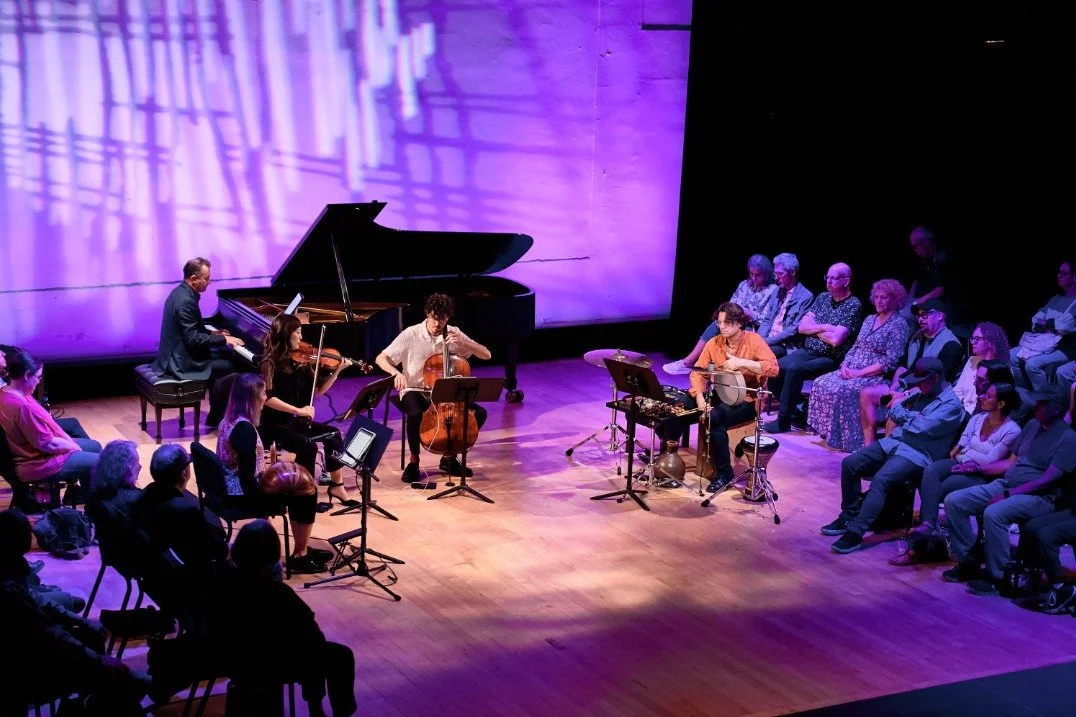
Either/Or premiere l’Algérie at Miller Theatre, NYC, October 1, 2024
Full Credits
Released on New Focus Recordings fcr479 on January 30, 2026
Recorded October 1, 2024 at Miller Theatre, NYC
Producer: Richard Carrick
Engineer: Joseph Branciforte
Editing: Richard Carrick
Mixing and mastering: John Escobar in RedRoom of EscobarMusic
Mixing and mastering assistant: Mar Giménez Marín
Cover painting: “Abundance” by Nomi Jovál (used by permission)
Additional paintings by Nomi Jovál
Design: Marc Wolf, marcjwolf.com
Either/Or eitherormusic.org
Richard Carrick richardcarrick.com
Bahar Badieitabar instagram.com/baharbadiei
Jennifer Choi jenniferchoi.com
Justin Jay Hines justinhinesmusic.com
John Popham johnpatrickpopham.com